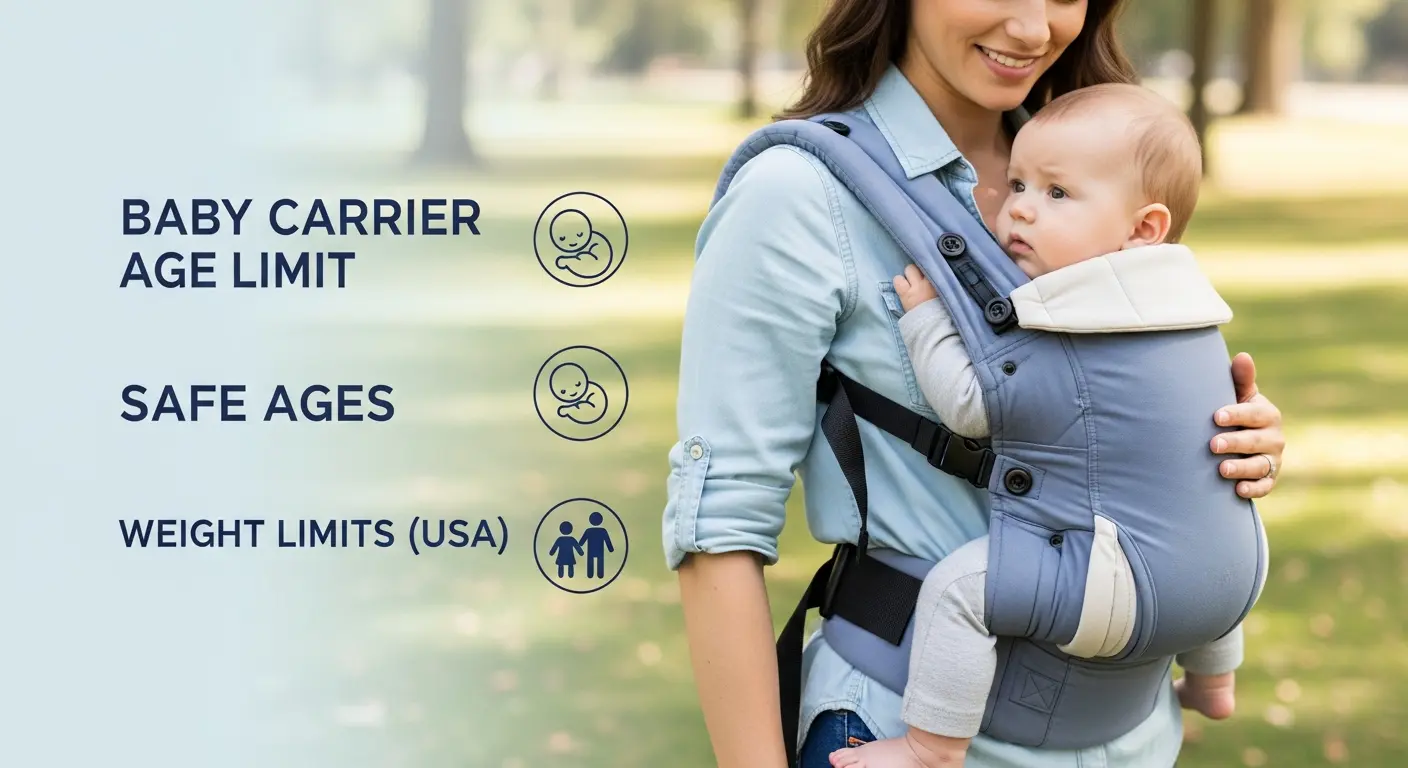
Understanding the baby carrier age limit is one of the most important steps for parents who want to keep their little ones safe, comfortable, and close. In the United States, more parents are choosing baby carriers for everyday errands, grocery runs, walks, and even household tasks. Carriers make life easier, but they also come with specific age and weight rules that should never be ignored. These age guidelines help protect your child’s neck, spine, breathing, and overall comfort. When used correctly, a baby carrier can be a lifesaver, but if used too early—or for too long—it can become unsafe.
Many new parents wonder, “When can I start using a baby carrier?” or “How long can my baby stay in it?” The answers depend on your baby’s growth, weight, body control, and the type of carrier you choose. This is why understanding the baby carrier age limit matters so much. Using a carrier outside the recommended age range may affect your baby’s posture or breathing, especially for newborns who need extra support.
Another reason age limits are important is that every type of carrier is designed for a specific stage of development. A newborn cannot use a hiking backpack carrier, and a 2-year-old will not fit comfortably in a stretchy wrap meant for small infants. Learning the right match between your baby’s age and the type of carrier keeps both of you relaxed and safe.
In this complete guide, you will find simple explanations, clear recommendations, and parent-friendly tips based on safety rules commonly followed in the USA. Whether you have a newborn, infant, or toddler, this guide will help you understand how long each carrier is safe to use, how to check if your child is within the baby carrier age limit, and what signs mean it’s time to switch or stop.
What Is the Baby Carrier Age Limit?
The baby carrier age limit refers to the range of ages and weights for which a carrier is considered safe. While it may seem like a simple question, the answer can change depending on your baby’s size, head control, physical development, and the carrier’s design. Some carriers are meant for tiny newborns, while others are built for big toddlers nearing preschool age.
In the U.S., most carriers follow a similar pattern: newborns start in soft, supportive carriers; growing babies move to structured carriers; and older toddlers transition to backpack-style carriers. But instead of relying only on age, weight is usually a more reliable measurement. For example, two babies who are both 6 months old may have very different body sizes. One might weigh 14 pounds while the other weighs 22 pounds. The lighter baby may still need more head support, while the heavier baby might already fit well in a larger carrier.
Most baby carriers in the USA list a starting weight between 7–8 lbs, and many go up to 35–45 lbs for the upper limit. Some specialty toddler carriers go even higher. This wide range exists because children grow at different speeds. That’s why experts always recommend following the manufacturer’s instructions rather than assuming all babies fit the same age limit.
Another important thing to remember is that age limits also depend on your baby’s physical abilities. Can your baby hold their head up? Can they sit on their own? Can they spread their legs comfortably in an ergonomic position? These small details help you choose the right carrier for the right stage.
The goal of understanding the baby carrier age limit is simple: keep your baby safe while making your daily routine smoother and more comfortable. When you use a carrier within the recommended age and weight range, you protect your baby’s spine, hips, and airway while enjoying hands-free mobility.
Baby Carrier Age Limit by Type of Carrier
Different carriers come with different rules. Each type has its own recommended age limit, weight limit, and best-use situation. Knowing which carrier fits your baby’s stage can help prevent discomfort and keep your child safe. Here is a breakdown of the most common carrier types used in the USA and their typical baby carrier age limit recommendations.
Wrap Carrier Age Limit
Wrap carriers are popular for newborns because they offer a snug and secure fit that mimics the feeling of being held. These carriers usually support babies from 7 lbs up to 25–35 lbs, depending on the brand. While age may vary, most babies use wrap carriers from birth until around 12–18 months. After that, they may feel too heavy or active for a stretchy wrap.
The wrap carrier age limit depends mostly on the fabric stretch and your baby’s comfort. Stretchy wraps work best for small babies, while woven wraps can safely hold older toddlers. Still, always check the brand’s instructions to avoid going over the safe limit.
Soft-Structured Carrier Age Limit
Soft-structured carriers (SSC) are the most commonly used carriers in the USA. They often include padded straps, buckles, and adjustable seat panels. These carriers typically support babies from 7–8 lbs up to 45 lbs, making them suitable for newborns (with an infant insert), infants, and toddlers.
Parents love SSC carriers because they last through several growth stages. The baby carrier age limit for this type is usually from birth to about 3–4 years old, depending on your child’s weight.
Sling Carrier Age Limit
Ring slings and pouch slings are great for quick ups and downs. Sling carriers generally support babies from birth up to 35 lbs. Most parents use them for newborns through the first year. After that, toddlers may feel too heavy on one shoulder, making longer wear uncomfortable for the parent.
Backpack Carrier Age Limit
Hiking backpack carriers have a specific baby carrier age limit. These carriers are not safe for newborns or small infants. They require strong neck control and usually a sitting ability. Most brands recommend a minimum age of 6–9 months, with a limit of 40–50 lbs. Many U.S. families use backpack carriers until their children are around 4 years old for outdoor activities.
Each type offers unique benefits, but using the right carrier at the right age is what makes the experience safe and enjoyable.
Newborn Baby Carrier Age Limit
Newborns require the most support, which is why understanding the newborn baby carrier age limit is essential. In the United States, newborns are often placed in soft wraps, ring slings, or structured carriers with infant inserts. These carriers are designed to protect delicate neck muscles, developing spines, and tiny airways.
Newborns can usually start using a carrier from birth, as long as they weigh at least 7 lbs and the carrier is approved for newborn use. But age alone is not enough. The carrier must allow the baby to stay in a “C-shaped” spine position and “M-position” legs for healthy hip development. Poor positioning can affect breathing and hip alignment, which is why careful carrier selection matters.
For newborns, the first few months are all about support. Your baby cannot hold their head up, so the carrier must have firm neck support. Babies should always face inward until they are old enough for better head and upper-body control.
Most newborns outgrow the newborn stage in carriers around 3–5 months, depending on growth speed. After this stage, many parents switch to a soft-structured carrier without an infant insert. Still, every baby develops differently, so watch for body control, leg spread, and comfort.
The newborn baby carrier age limit depends on:
- Neck strength
- Airway safety
- Correct positioning
- Comfort for both baby and parent
The right carrier makes newborn life easier, letting you move freely while keeping your baby close and safe.
Infant Baby Carrier Age Limit
Infants—babies aged between 4 and 12 months—need different types of support than newborns. Their bodies are stronger, but they still need head, spine, and hip protection. The baby carrier age limit for infants usually ranges from 4 months to around 12–18 months, depending on the carrier’s design and the baby’s size.
Infants may transition into wider-set carriers that allow more movement but still keep their legs in the healthy “M-position.” Many carriers for this stage offer multiple carry positions, such as:
- Front-inward
- Front-outward (usually after 5–6 months)
- Hip carry
- Back carry (often after 6 months)
A key part of this stage is watching for developmental milestones. When your baby has strong head control and can sit with minimum support, you can move to more flexible positions. The infant age range is when many babies enjoy seeing the world, so some parents switch to forward-facing carries. Still, inward-facing is usually more ergonomic, especially for long wear time.
Weight is another factor. Infants grow quickly, and many reach 20–25 lbs before their first birthday. Make sure your carrier supports your baby’s current weight, not just their age.
The infant baby carrier age limit is all about balance—enough support for safety but enough flexibility for comfort.

Toddler Baby Carrier Age Limit
The toddler stage brings a whole new level of movement, independence, and curiosity. Once your child outgrows the infant phase, you may wonder how long it’s safe to continue using a carrier. The baby carrier age limit for toddlers usually falls between 18 months and 3–4 years, depending on your child’s weight, height, and physical development. Many carriers available in the USA are designed to support weights up to 35–45 lbs, which covers most toddlers comfortably.
At this age, toddlers still benefit from being carried, especially during long walks, family trips, grocery shopping, or moments when they simply want to feel close. A toddler carrier often has a wider seat base, taller panel, and stronger straps to make carrying a bigger child easier on your back and shoulders. These carriers are built to distribute weight evenly, ensuring comfort for both of you.
As your toddler grows, pay attention to fit. Their legs should still sit in the ergonomic “M-position,” and their back should remain supported without slumping. If your toddler’s knees or shoulders start to extend past the carrier frame, it may be time to transition to a larger model.
Some U.S. parents even use specialized toddler or preschool carriers designed to hold up to 50–60 lbs, making them ideal for hiking or theme parks where little legs get tired quickly. The key is knowing when your child has outgrown their current carrier. If the carrier no longer supports their spine, hips, or legs, or if you feel excessive pressure on your shoulders, it’s time to reassess.
The toddler phase still depends heavily on your baby’s weight and comfort. The right carrier can keep your child safe while giving you much-needed mobility.
Baby Carrier Age Limit Based on Weight
While age is helpful, weight is usually the more accurate measure for choosing a safe carrier. The baby carrier age limit is often listed as a weight range, and most U.S. brands follow a similar pattern. Newborn carriers usually start at 7–8 lbs, infant carriers go up to around 25–30 lbs, and toddler carriers reach 40–60 lbs, depending on the model.
Weight matters because it directly affects how the carrier supports your child’s spine, hips, and posture. A carrier designed for a newborn cannot safely support a 25-lb baby. It will strain the fabric and buckle system, making it unsafe. Likewise, a carrier built for toddlers will be far too wide and bulky for a newborn, putting pressure on their hips in a way that could affect healthy development.
Parents in the USA are encouraged to read the weight tags printed on the carrier or check the manufacturer’s website. These weight recommendations are tested for safety and durability. Ignoring them may put your child at risk of slipping, poor posture, or fabric tears.
Even if your child fits within the age range, always rely on their weight to confirm the carrier is safe.
Baby Carrier Age Limit and Safety Standards in the USA
Safety is always the top priority, especially when dealing with newborns and young children. The United States follows strict guidelines to ensure carriers meet high safety standards. When researching the baby carrier age limit, you should also check whether your carrier meets recognized U.S. certifications.
Many baby carriers in the USA follow standards set by:
- ASTM International
- Consumer Product Safety Commission (CPSC)
- Juvenile Products Manufacturers Association (JPMA)
These groups test carriers for durability, stability, stitching strength, buckle reliability, and safe positioning. When a carrier meets these standards, it means the product has been tested through various simulations to ensure it is safe for daily use.
Always buy from trusted brands and avoid carriers that don’t clearly list their age and weight guidelines. If the label is missing or unclear, don’t take chances. The baby carrier age limit is only valid if the product has passed proper safety testing.
How to Check if Your Child Has Reached the Baby Carrier Age Limit
Even if your carrier lists a high age or weight limit, your child may outgrow it earlier based on height, posture, or comfort. Here are clear signs your baby or toddler has reached the baby carrier age limit:
- Their legs hang too far out – If your child looks uncomfortable or their knees are not higher than their hips, the carrier may be too small.
- Their head sticks out above the panel – The back panel should support their spine up to the shoulders for younger babies.
- You feel shoulder or back pain – When the carrier no longer distributes weight properly, it may be time to size up.
- Fabric feels stretched or loose – This can change positioning and affect safety.
- Your child struggles or leans out – This may indicate they no longer feel secure in the carrier.
Doing a quick fit check before every use helps you keep your child safe and comfortable.

Mistakes Parents Make With Baby Carrier Age Limits
Many parents in the USA unknowingly make mistakes when it comes to the baby carrier age limit. The most common mistake is using a carrier too early, especially for newborns who need strong neck support. Another common error is exceeding the weight limit, which weakens the fabric and buckles, putting your baby at risk of falling or improper positioning.
Some parents also forget to adjust the carrier as their baby grows. A carrier that fit well at 3 months may need strap changes by 6 months. Not adjusting the fit can cause hip misalignment or strain your back.
Ignoring the baby’s signals is another mistake. If your child shows signs of discomfort—arching, slumping, or crying excessively—it may be a sign the carrier is no longer suitable.
Understanding and following the baby carrier age limit prevents accidents and ensures the healthiest carrying experience.
Choosing the Right Carrier for Your Baby’s Age
Choosing the right carrier is easier when you understand what each age group needs. For newborns, soft wraps and slings work best because they mold to the baby’s shape. For infants, structured carriers with adjustable seats offer better support. For toddlers, you need a sturdy carrier with a wide panel and strong straps.
When choosing a carrier in the USA, consider:
- Your baby’s current weight
- Their body control
- Your comfort
- Your lifestyle (city walking, travel, hiking, etc.)
The goal is to match your child’s stage with the right product, not force them into a carrier just because it’s available.
Baby Carrier Age Limit for Outdoor Activities
Carriers play a huge role in family adventures, from hiking trails to zoo trips. But outdoor carriers come with their own baby carrier age limit rules. Newborns should never be placed in backpack carriers, as these require strong head and torso control. Most outdoor-specific carriers recommend a minimum age of 6–9 months.
These structured backpack carriers often support up to 40–50 lbs, making them ideal for toddlers who still need help on long walks. Always ensure your child can sit unassisted before using a hiking carrier.
Breathability, weather protection, and secure buckles matter even more outdoors, so always prioritize safety before convenience.
Baby Carrier Age Limit and Hip Health
Hip health is a major focus in the babywearing world. The baby’s hips should always be in the natural “M-position,” with knees higher than the bottom. Using a carrier outside the recommended baby carrier age limit may force your child’s legs into unsafe angles. This is why newborns require narrow-position carriers, and older babies need wider seats.
Pediatric experts in the U.S. encourage choosing carriers labeled as “hip-healthy.” This ensures the seat supports the thighs and avoids unnecessary pressure on joints.
Keeping your child’s hips safe comes down to proper positioning and using a carrier designed for their developmental stage.
Baby Carrier Age Limit for Air Travel
Traveling with a baby can feel overwhelming, but a carrier makes airport navigation easier. Most airlines in the USA allow baby carriers during boarding, walking through terminals, and even during takeoff and landing, depending on the airline’s policies. Air travel does not change the baby carrier age limit, but it does require choosing a comfortable model that supports long wear.
Soft-structured carriers are the most travel-friendly option because they hold babies securely and evenly distribute weight. As long as your child stays within the carrier’s weight guidelines, you can use it during flights. Make sure your baby is positioned upright for proper airflow.
Finally: Understanding the Baby Carrier Age Limit
Knowing the baby carrier age limit is essential for keeping your child safe through every stage—newborn, infant, and toddler. When you choose a carrier that matches your child’s age, weight, and development, you create a comfortable and secure carrying experience. From short errands to long outdoor trips, the right carrier makes life easier while keeping your baby close and protected. Always check the weight limits, follow safety guidelines, and listen to your child’s needs. With the right knowledge, babywearing becomes a safe, helpful, and joyful part of everyday life.